You find a project you love. Maybe it’s a tiled fireplace, painted kitchen cabinets, new flooring or some fabulous built-in you saved on Pinterest six months ago.
Your first thought is usually one of two things:
I could totally do that.
Or:
There is absolutely no way I could do that.
I’ve learned that neither one is particularly useful.
Before deciding whether I can—or should—DIY a project, I need to know what the project actually involves.
Because sometimes a project that looks intimidating turns out to be surprisingly manageable once you break it into pieces. And sometimes the cute little “easy weekend DIY” you’ve been admiring requires seventeen tools you don’t own, materials you can’t find locally, skills you’ve never attempted and three days of your life you’d rather spend doing literally anything else.
There is a better way to decide.
Over the years, I’ve realized I run potential DIY projects through essentially the same set of questions every time.
It’s a formula.
Like math. But different.
1. Research the Entire Project—Not Just the Pretty Part
Before you decide whether you can do a project, find out exactly what you’re signing up for.
Read tutorials. Watch videos—more than one. Look specifically for tutorials from people who show the entire process, including preparation and finishing.
If you’re tiling, don’t just research how to stick tile to a wall. How do you prepare the surface? How do you cut the tile? What happens around outlets or corners? How long does everything need to cure? How do you grout it?
Write down the basic steps.
A big, scary project often becomes much less intimidating when it stops being ONE GIANT PROJECT and becomes eight smaller jobs.
2. What Skills Does the Project Actually Require?
Now look at those individual steps.
Put them into three categories:
I know how to do this.
I can learn how to do this.
I need help with this.
That middle category is where a whole lot of DIY lives.
You don’t need to have installed tile before to learn how to use a manual tile cutter. You don’t need to be a professional painter to learn how to properly prep a cabinet.
But there are also skills you may decide you don’t want to learn on your actual house.
That’s useful information, too.
3. Do You Know Someone Who Has Done It Before?
This one deserves more credit than it gets.
Think about your people.
Do you have a friend, neighbor, relative or coworker who has tackled something similar?
You aren’t necessarily asking them to come spend their Saturday doing your project.
Sometimes what you really need is somebody you can text a picture and ask:
“Is this supposed to look like this?”
They may know the trick that wasn’t mentioned in the tutorial. They may have the tool you need sitting in their garage. They may be willing to show you the one step you’re nervous about.
And sometimes knowing there is an experienced person you can call if things go sideways is enough to make a project feel possible.
DIY doesn’t have to mean doing everything alone.
4. Make the REAL Tools and Materials List
Don’t buy anything yet.
First, make the complete list.
What materials will you need? How much? Are they available locally? Do they have to be ordered? How long will shipping take?
Then do the same thing with tools.
What do you already own?
What can you borrow?
What can you rent?
What would you have to buy?
And perhaps most importantly:
Are you comfortable using those tools?
Years ago, I wanted to install tile but had absolutely no interest in operating a wet saw. Once I researched the project, I discovered that the cuts I needed could be made with an inexpensive manual tile cutter.
That one piece of information changed whether the project felt doable.
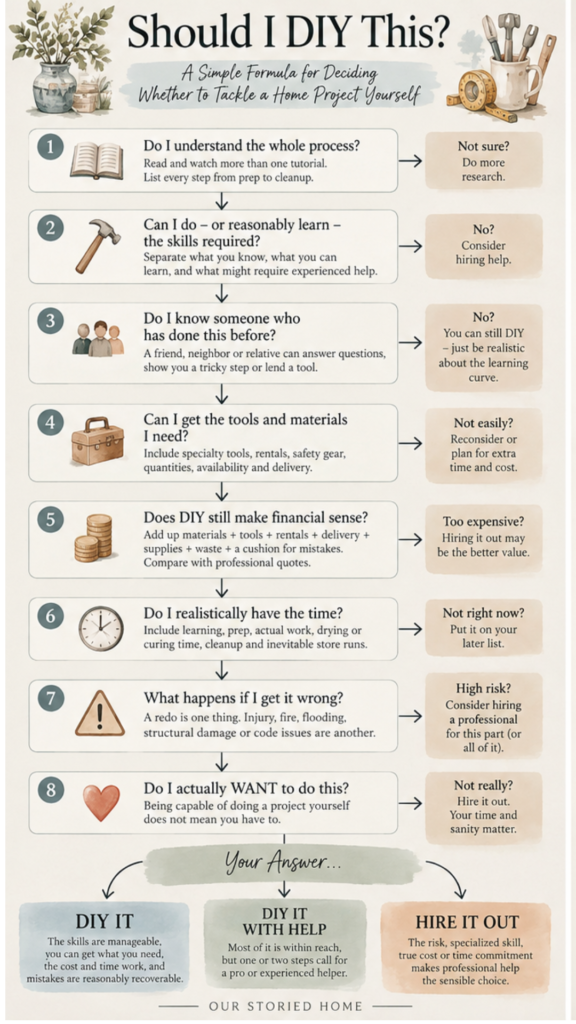
5. Calculate What the DIY Will REALLY Cost
The material price isn’t the project price.
Add up:
Materials + tools + rentals + delivery + supplies + waste + mistakes.
Because you’re probably going to make one.
I certainly am.
Then compare that number with what it would cost to hire the project out.
Sometimes DIY saves a fortune.
Sometimes after buying a specialty tool you’ll never use again and spending three weekends doing something you hate, the professional quote starts looking awfully attractive.
6. Calculate Your Real Time
The internet lies about project time.
Okay, maybe not intentionally. 😂
But “Easy Two-Hour DIY!” may mean two hours for someone who has made six of them, already owns every tool and doesn’t have to stop halfway through because she forgot the damn caulk.
Include:
research + shopping + prep + actual work + drying/curing time + cleanup + inevitable additional trips to the store.
Then ask yourself whether that amount of time fits your life right now.
7. What Happens If You Screw It Up?
This may be the most important question in the entire formula.
Not:
“Could I make a mistake?”
You will.
Ask:
“What happens if I make a mistake?”
If the answer is I repaint it, I buy another board or I have to pull off three crooked tiles, the risk may be perfectly acceptable.
If the answer involves fire, flooding, structural damage, dangerous materials, building codes or somebody getting hurt, you’ve entered a different category.
That doesn’t necessarily mean you can’t participate in the project. It may mean you DIY the parts you’re comfortable with and hire a qualified professional for the part where the consequences matter.
8. Do You Actually WANT to Do It?
This is a rule.
Just because you can DIY something doesn’t mean you have to.
Maybe you’ve done the research. You possess the skills. You own the tools. You could absolutely do it.
And you’d rather stick a fork in your eye.
Hire somebody.
Your time has value. Your frustration has value. Your weekend has value.
There is no DIY trophy.
So…Should You DIY It?
Once you’ve answered those questions, the giant scary project should look considerably different.
You’re usually left with one of three answers:
DIY IT.
The skills are manageable, you can get what you need, the time and cost make sense and the consequences of mistakes are reasonable.
DIY IT—WITH HELP.
Most of the project is within your abilities, but there’s a step where an experienced friend or professional makes sense.
HIRE IT OUT.
The risk, skill, true cost, time—or simply your complete lack of desire to spend three Saturdays doing it—makes hiring someone the better choice for you.
None of those answers means you’re more or less capable.
It means you assessed the project before you attacked the project.
And that’s the part I wish more DIY tutorials talked about.
Before you ask:
“Can I do this?”
Find out exactly what this involves.
You might discover you’re capable of a lot more than you thought.